What do we need to run it?
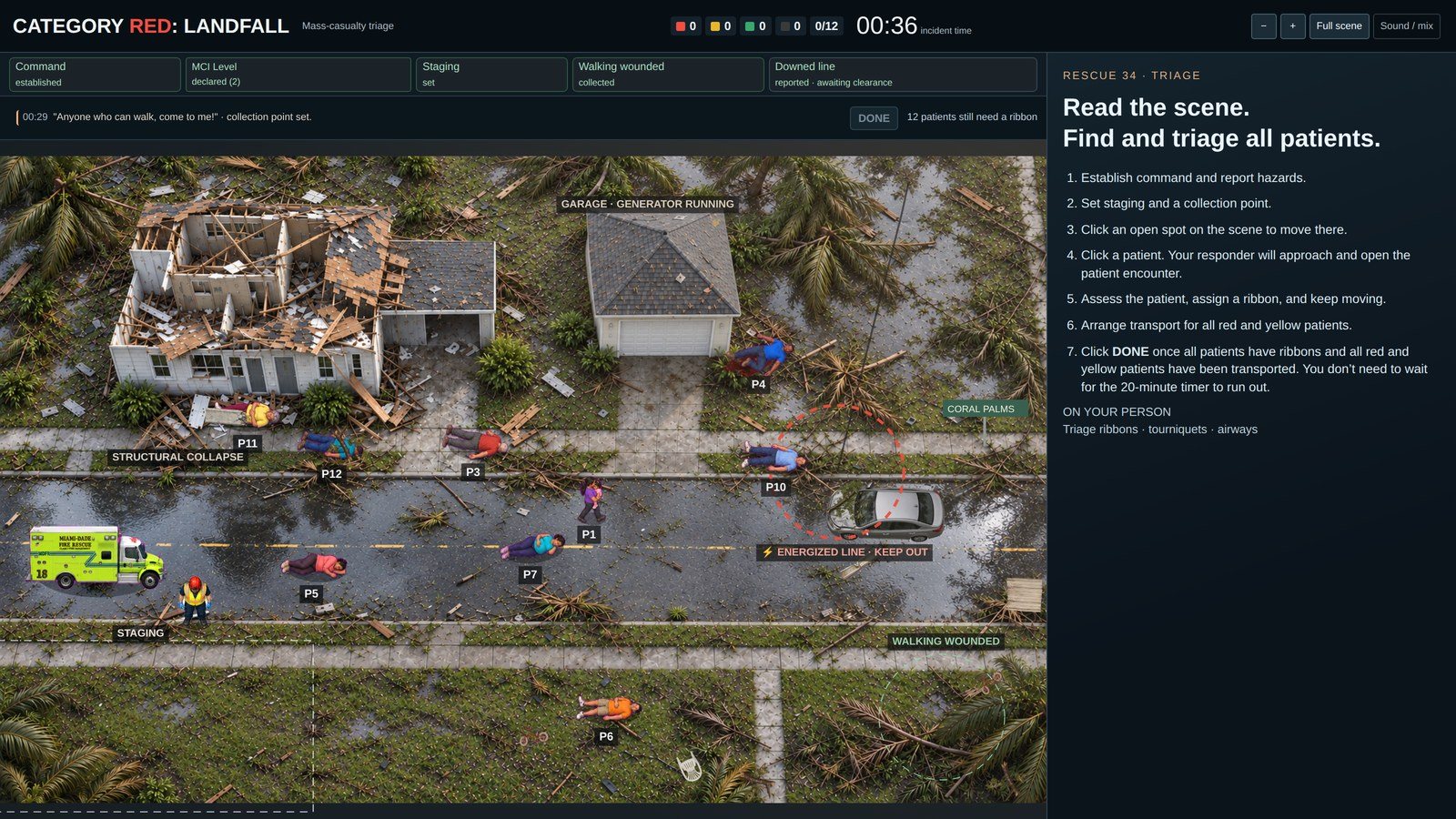
Any modern browser on any computer — the training-room laptop as it is. There is nothing to install, no accounts and no IT ticket. The game ships as a single file or a single link.
Is it a clinical reference?
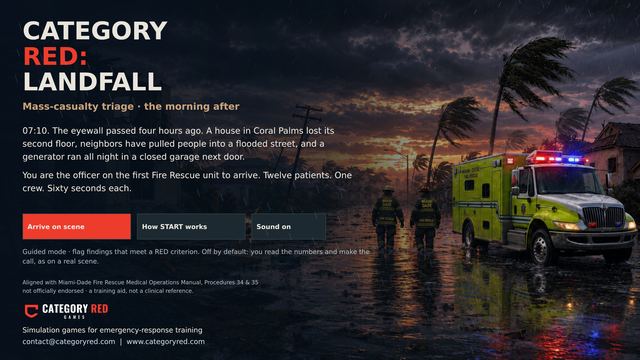
No. It is a training aid aligned with Miami-Dade Fire Rescue Procedures 34 & 35 (rev. 07/2019). Your agency's protocol and medical director govern. It is not endorsed by or affiliated with Miami-Dade Fire Rescue.
Our department uses a different triage protocol. Can it be adapted?
Yes. Another department's protocol, a different disaster, local hospitals and unit numbers — the patients and the rules are designed to change. Custom versions are produced on request.
How long is one run?
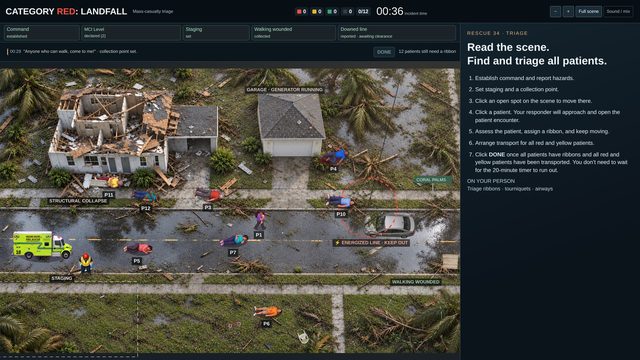
About 20 minutes on the real-time incident clock, followed by the Post Incident Analysis. It fits inside a shift briefing or a classroom block, and it can be replayed — patient placement changes every run.
Does it work for people who are not clinicians?
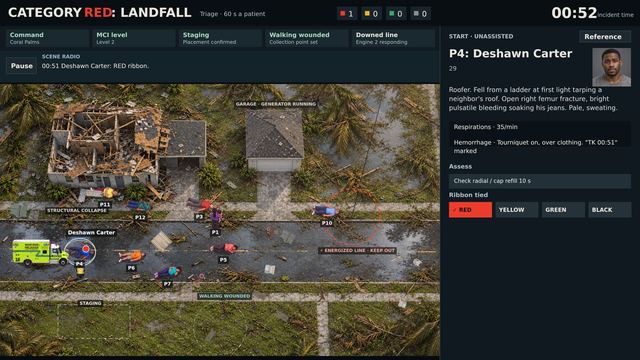
A guided mode flags findings that meet a RED criterion, which suits orientation, dispatch, emergency-management staff and students. By default it is off: the medic reads the numbers and makes the call, as on a real scene.
How is a run graded?
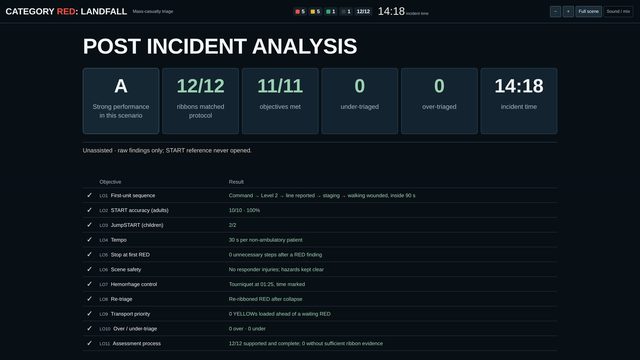
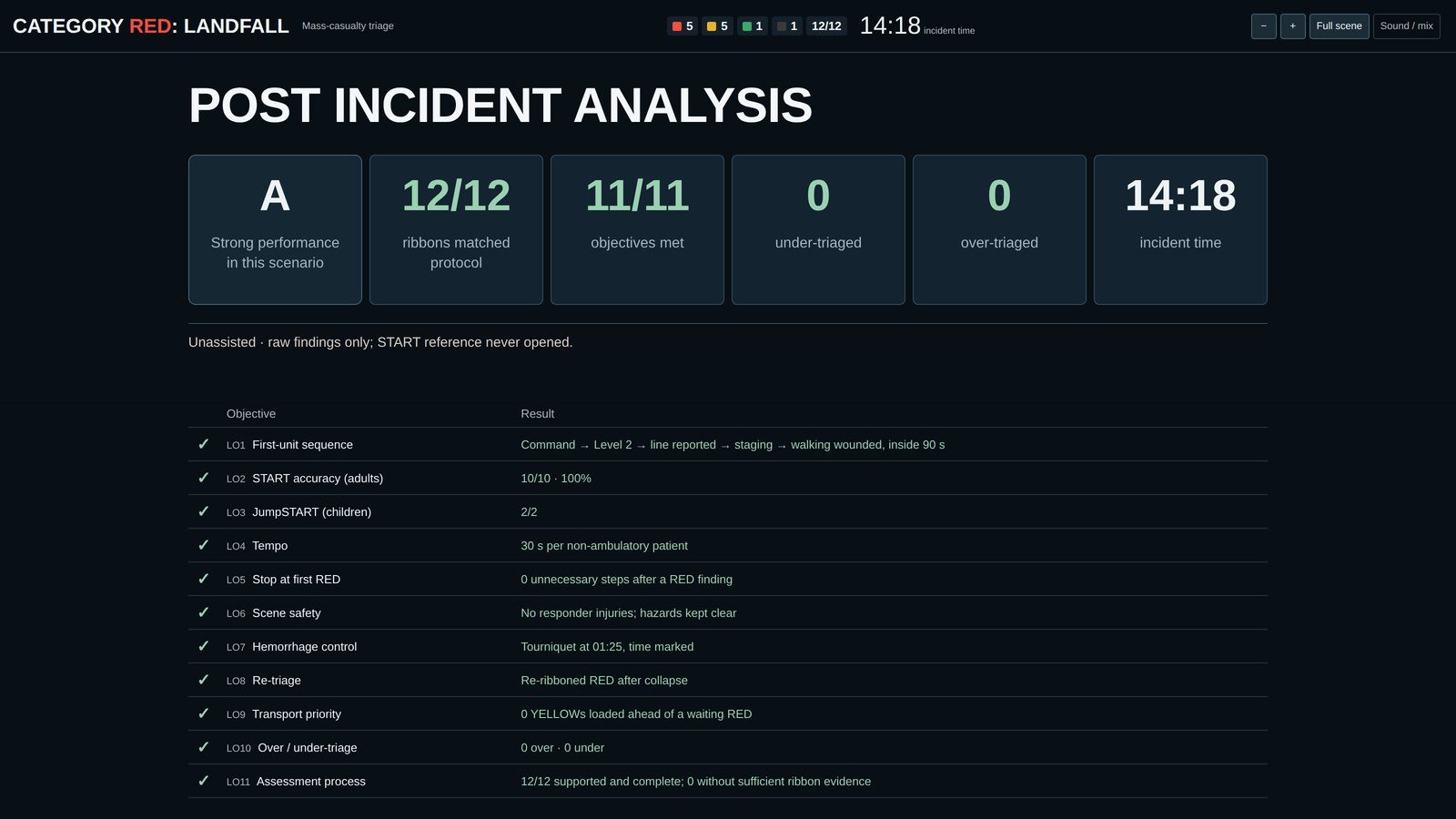
A to D. D means under-triage or an uncontrolled bleed; C a missed critical classification or ribbons the recorded findings do not support; B protocol held but tempo or sequence slipped; A the run as procedure describes it. Under the grade sit eleven pass/fail objectives, a case review per patient and the radio log.
What counts as a supported ribbon?
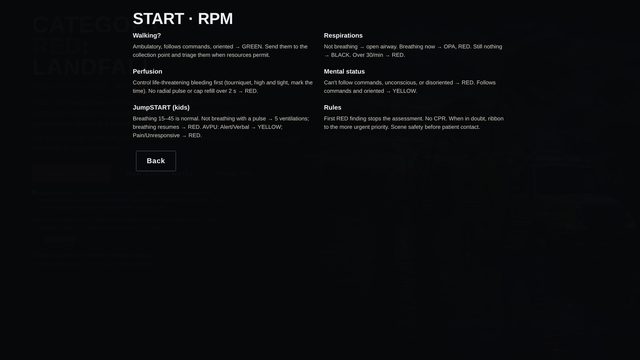
The findings that justify it must be on record for that patient — walking ability for GREEN; respirations, perfusion and mental status for YELLOW; a decisive RED finding for RED; respirations still absent after the airway is opened for BLACK; and for a child, the pulse checked before the five rescue breaths. A correct ribbon without the evidence behind it is flagged in the debrief and caps the grade at C.
How is it licensed?
Department licenses and custom scenarios are available on request. Tell us your agency, the number of stations or seats, and whether you need a custom version; we will send a playable build, the gameplay video and scenario documentation.